
Wrestling asks more of a kid’s body than almost any other youth sport. Two-hour practices, hard conditioning, live wrestling, and then school the next day. What your wrestler eats matters, but not in the complicated way people make it sound.
This is a straightforward guide for parents. No diet plans, no supplements, no weight-cutting talk. Just the basics that actually move the needle when your kid is training at Shamrock Wrestling Club in Somerset and Fall River.
Wrestling puts real demands on a growing body
Wrestling burns through energy fast. A single live go can leave a kid gassed for ten minutes. Multiply that by a full practice and you’re looking at one of the most metabolically expensive sports in school athletics.
Kids who eat well recover faster, practice harder, and get sick less often. That is the whole reason this matters.
What a young wrestler should actually eat
Forget special athlete diets. Young wrestlers need the same thing any growing kid needs, just more of it. Four categories cover almost everything:
- Protein at every meal: eggs, chicken, beef, fish, beans, yogurt, milk
- Carbs kids will actually eat: rice, pasta, potatoes, oatmeal, whole-grain bread, fruit
- Fats that don’t come out of a box: nuts, olive oil, avocado, cheese, peanut butter
- Vegetables: whatever they’ll eat, frozen is fine
The goal isn’t perfection. It’s consistency. A kid who eats three real meals a day will almost always outperform a kid living on granola bars and fruit snacks.
Before practice
Wrestling on an empty stomach makes kids sluggish. Wrestling on a full stomach makes them sick. The sweet spot is a small meal one to two hours before practice.
Good pre-practice options:
- Peanut butter and banana on toast
- Turkey sandwich and an apple
- Bowl of oatmeal with milk
- Leftover chicken and rice
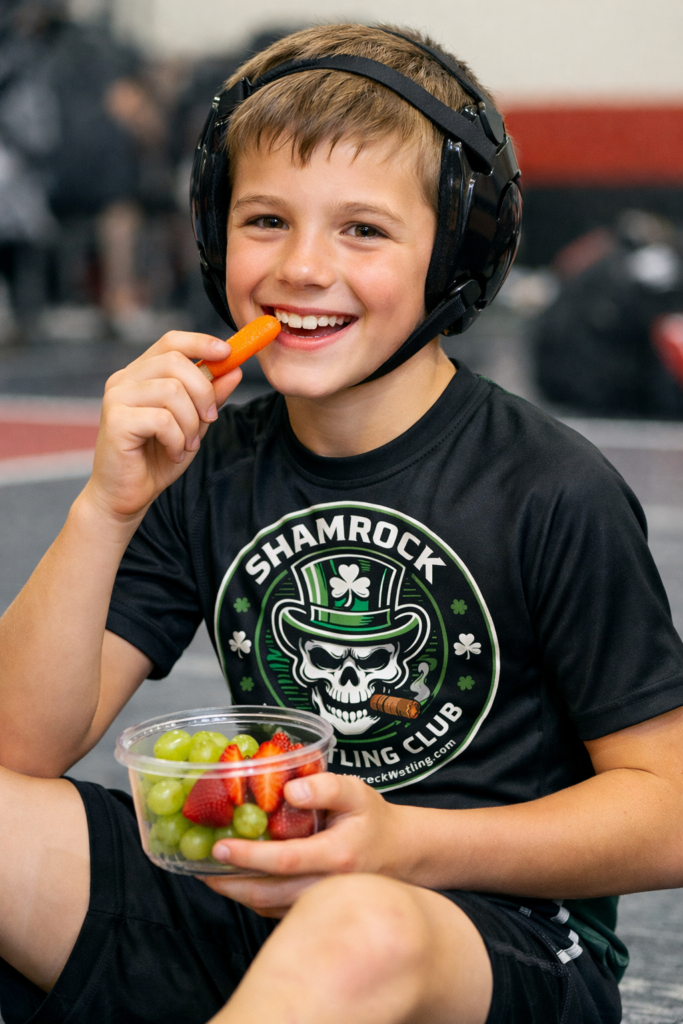
If there’s less than an hour before practice, keep it small. A banana, a handful of crackers, a glass of chocolate milk. Fueling matters more than timing it perfectly.
After practice
This is the part parents miss most. Kids get home at 7 or 8 PM from Monday and Thursday practices and a lot of them don’t eat anything real. That catches up fast over a six-month season.
Get a legitimate meal in them within about an hour after practice. Protein plus carbs plus some vegetables. It doesn’t have to be fancy. A plate of chicken, rice, and broccoli works. So does a turkey wrap and fruit. So do leftovers.
If you want to keep your wrestler healthy and their body strong enough to handle hard training, the post-practice meal is the easiest win you have.
Tournament days
Tournament eating trips up a lot of first-year families. Kids get nervous, skip breakfast, wrestle bad, and then blame everything else.
Rules of thumb:
- Eat a normal breakfast two to three hours before weigh-ins or the first match
- Pack a cooler with real food: sandwiches, fruit, pretzels, water, nut butter, jerky
- Stay away from arena pizza, fries, and soda until the day is over
- Snack lightly between matches: a half sandwich or fruit, not a full meal
Tournaments run long. A kid who eats steady from 7 AM to 3 PM will wrestle better in the last round than the kid who had one breakfast sandwich and then nothing.
Hydration is the thing most kids mess up
Most young wrestlers show up to practice underhydrated. They drink a little at dinner, a little at lunch, and then head to the mat. Then they sweat through a 90-minute practice.
A simple target: a full water bottle with every meal, and a water bottle at practice. Chocolate milk after hard practices is underrated. It’s cheap, it has protein and carbs, and kids will actually drink it.
Avoid energy drinks entirely for youth wrestlers. They don’t need the caffeine, and they don’t need the sugar crash in the middle of practice.
Skip the weight-cutting talk for youth wrestlers
One of the oldest wrestling myths is that young kids need to cut weight. They don’t. K-5 and middle school wrestlers should eat, grow, and compete at whatever weight they naturally land at.
At Shamrock, we coach youth and middle school wrestlers to fuel up, not cut down. High school varsity programs have their own rules and medical oversight, but for the K-8 range the answer is simple: feed your athlete.
If you’ve heard otherwise, check out our post on common wrestling myths parents believe.
What parents can do at home
You don’t need to become a nutritionist. A few habits move the needle:
- Keep fruit, milk, and quick protein snacks stocked
- Plan dinner on practice nights so it’s not a scramble at 7:30 PM
- Pack the tournament food bag the night before
- Make water the default drink, not juice or soda
- Eat meals together when you can
Kids copy the people around them. When parents eat like adults, kids start to eat like athletes.
Build a stronger wrestler at Shamrock
Nutrition is one piece. The other is showing up and training hard. Shamrock Wrestling Club runs year-round practices at our Somerset, MA location for Grades K-5 (Monday/Thursday 5:30-6:30 PM), Middle and High School (Monday/Thursday 6:30-8:00 PM), and Saturday (10:00 AM-12:00 PM). Unlimited sessions are $100/month.
If your kid is new to the sport, start with a free K-7 youth session and see how they handle a real practice. When you’re ready, register for wrestling in Somerset and Fall River and get them on the mat.